Pearson Edexcel · A-Level · English Literature
Course version: 9ET0 · Version from Sept 2015
Poetry – Section A: Post-2000 Poetry – Poems of the Decade: An Anthology…
Full specification wording
Component 3: Poetry – Section A: Post-2000 Poetry – Poems of the Decade: An Anthology of the Forward Books of Poetry 2002–2011: To My Nine-Year-Old Self Helen Dunmore
Helen Dunmore’s ‘To My Nine-Year-Old Self’ explores the chasm between childhood vitality and adult fragility.
Checked against the Pearson Edexcel 9ET0 specification (opens in a new tab) on .
- Point 8 of 20
- 4 key terms
Study notes
From the checked teaching notes for this specification point.
The idea
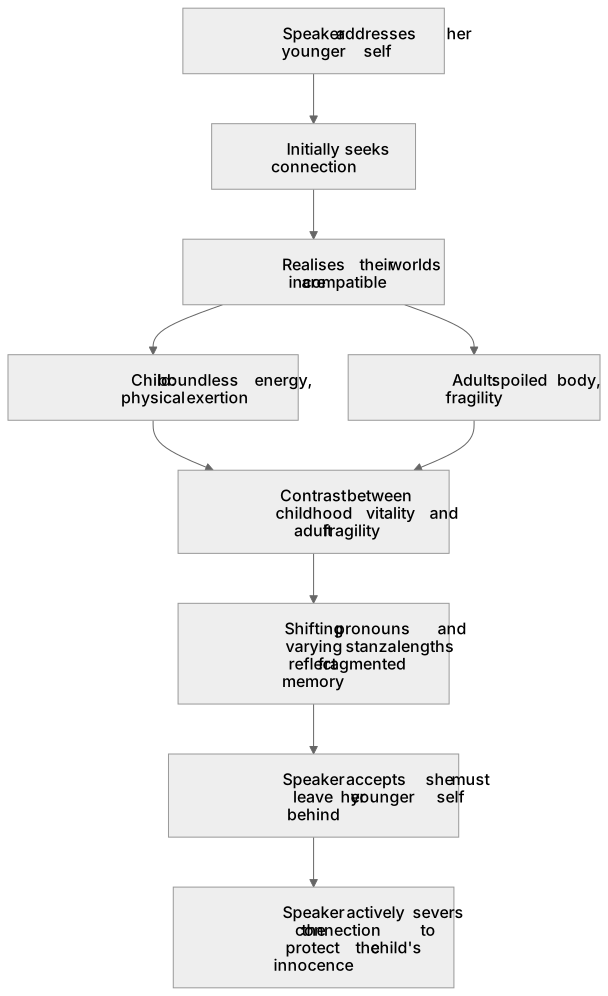
Helen Dunmore’s ‘To My Nine-Year-Old Self’ explores the chasm between childhood vitality and adult fragility. The speaker addresses her younger self, initially seeking connection but realising their worlds are incompatible. Dunmore uses vivid imagery of physical exertion, such as ‘scabbed knees’ and ‘loll on ropes’, to contrast the child’s boundless energy with the adult’s ‘spoiled body’. The poem’s structure, with shifting pronouns and varying stanza lengths, reflects the fragmented nature of memory and the speaker’s acceptance that she must leave her younger self behind. The metaphor of ‘white paper’ highlights the child’s unwritten future, contrasting sharply with the adult’s lived experience and accumulated regrets.
What earns the marks
- Analyse the use of pronouns (e.g., 'I', 'you', 'we') to track the shifting distance between the adult speaker and the child.
- Evaluate the contrast between the dynamic, active verbs associated with the child and the static, cautious language of the adult.
- Discuss the significance of physical imagery, particularly scars and injuries, as markers of both childhood recklessness and adult vulnerability.
- Examine the poem's conclusion, where the speaker actively severs the connection to protect the child's innocence.
Common mistakes and how to put them right
Assuming the poem is purely nostalgic.
Put it right: Acknowledge the darker undertones of physical decay and the speaker's deliberate distancing from the child.
Treating the adult and child as entirely separate characters.
Put it right: Discuss them as fractured aspects of the same identity separated by time and experience.
Ignoring the structural shifts in the poem.
Put it right: Analyse how the stanza lengths and enjambment reflect the flow of memory and the emotional hesitation of the speaker.
Exam tips
- Compare the presentation of childhood memory in this poem with others in the anthology, such as 'Material' or 'A Leisure Centre is Also a Temple of Learning'.
- Focus on the sensory language used to describe the child's physical world to demonstrate how Dunmore builds a vivid picture of youth.
- Use the transition from 'we' to 'I' and 'you' as a structural focal point for your essay to show the breakdown of the speaker's internal connection.
Try the lesson
The start of the Component 3: Poetry – Section A: Post-2000 Poetry – Poems of the Decade: An Anthology of the Forward Books of Poetry 2002–2011: To My Nine-Year-Old Self Helen Dunmore lesson, made from checked teaching notes for this specification point.
Have a go first
In Helen Dunmore's 'To My Nine-Year-Old Self', what is the speaker's primary attitude towards her younger self?
Listen
Helen Dunmore’s ‘To My Nine-Year-Old Self’ explores the chasm between childhood vitality and adult fragility. The speaker addresses her younger self, initially seeking connection but realising their worlds are incompatible. Dunmore uses vivid imagery of physical exertion, such as ‘scabbed knees’ and ‘loll on ropes’, to contrast the child’s boundless energy with the adult’s ‘spoiled body’. The poem’s structure, with shifting pronouns and varying stanza lengths, reflects the fragmented nature of memory and the speaker’s acceptance that she must leave her younger self behind. The metaphor of ‘white paper’ highlights the child’s unwritten future, contrasting sharply with the adult’s lived experience and accumulated regrets. A strong answer earns marks for these points. Analyse the use of pronouns (e.g., 'I', 'you', 'we') to track the shifting distance between the adult speaker and the child. Evaluate the contrast between the dynamic, active verbs associated with the child and the static, cautious language of the adult. Discuss the significance of physical imagery, particularly scars and injuries, as markers of both childhood recklessness and adult vulnerability. Examine the poem's conclusion, where the speaker actively severs the connection to protect the child's innocence. A common slip: Assuming the poem is purely nostalgic. Instead, Acknowledge the darker undertones of physical decay and the speaker's deliberate distancing from the child. Exam tip: Compare the presentation of childhood memory in this poem with others in the anthology, such as 'Material' or 'A Leisure Centre is Also a Temple of Learning'.
See it
Key words
Say what each word means before you turn the card.
Childhood and innocence
Try answering aloud or in your head before turning the card.
The passage of time
Try answering aloud or in your head before turning the card.
Physicality and the body
Try answering aloud or in your head before turning the card.
Memory and regret
Try answering aloud or in your head before turning the card.
See every definition
- Childhood and innocence
- The child's boundless energy and unwritten future, which the speaker seeks to protect by severing the connection.
- The passage of time
- The chasm between childhood vitality and adult fragility, separating fractured aspects of the same identity.
- Physicality and the body
- Vivid imagery of physical exertion, scars and injuries marking both childhood recklessness and adult vulnerability.
- Memory and regret
- The fragmented nature of memory, reflected in shifting pronouns and varying stanza lengths, and the adult's accumulated regrets.
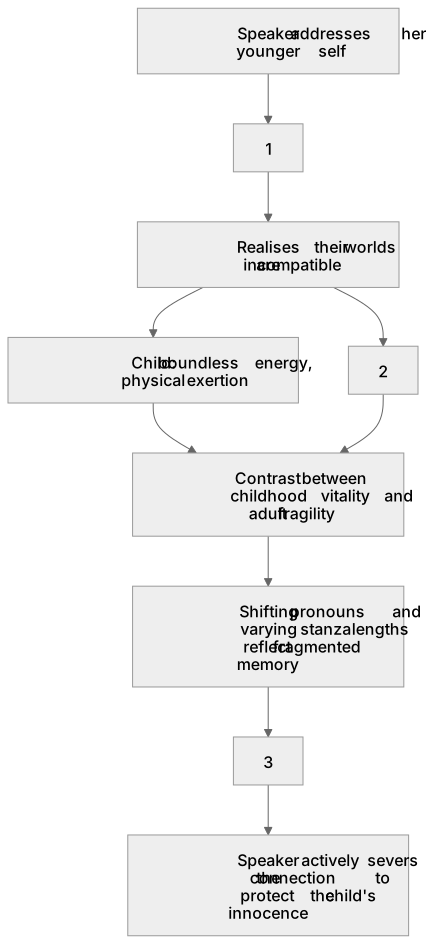
Label the diagram
Some boxes have lost their names. Pick the right name for each number.
1Box 1
2Box 2
3Box 3
There is more to this lesson
The full lesson goes on to check your understanding and help you earn the marks. Create a free account to carry on, with your progress saved.
A week of Premium from your first lesson · Then the free plan continues · No card, no charge
Test your understanding of Component 3: Poetry – Section A: Post-2000 Poetry – Poems of the Decade: An Anthology of the Forward Books of Poetry 2002–2011: To My Nine-Year-Old Self Helen Dunmore
Active recall beats re-reading. Take an instant quiz now to test what you’ve learned and lock it into long-term memory.
A week of Premium from your first lesson · Then the free plan continues · No card, no charge